
Genre: Metroidvania
Year: 2015
Developed by: Thomas Happ Games
Published by: Thomas Happ Games
Platforms: PC, PS4, XBOX One, Wii U, Switch, Linux, Vita
#72
Feeling Like: Synthvania
I don’t care that Axiom Verge wears its Metroid influence right on its sleeve. Hell, the whole suit is a Metroid clone, but if you’re going to do your own spin on something, you might as well start with something beloved. Thomas Happ did, and somehow made one of the best Metroid games available. All by himself.
Literally. He did everything – the graphics, the development, the audio, everything. One guy. Much like how Eric Barone made the best Harvest Moon game in Stardew Valley, Happ made the best 2D Metroid game in Axiom Verge. It nails the vibe in every manner; it’s creepy, it’s foreboding, it’s bizarre. It’s amazing.
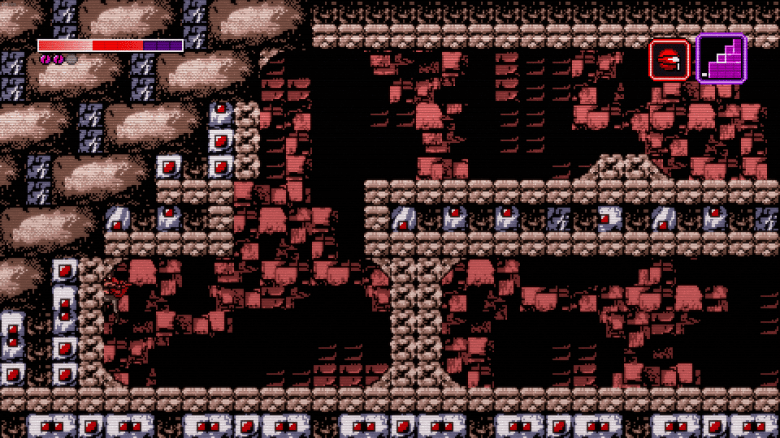
The synth soundtrack perfectly encapsulates being stuck on an unfamiliar, threatening location. “Trace Awakens” could be from Blade Runner or Robocop, with the beats hammering home urgency and those strange twangs sounding like an inhuman guitar urging you on. “Cellular Skies” sounds like it’s pulled right from the Matrix, a mix of mechanical and organic. “Inexorable” is certainly the game’s most discussed tune, for better or for worse. I personally loved it – this mysterious woman wailing at me was mildly shocking. As soon as you enter the area, the first thing you hear is this voice. I don’t know what language she’s speaking/singing, but it’s not English. Why would it be, in Axiom Verge? I’m supposed to feel unnerved, and intimidated. The audio succeeds in doing so, and more.
I am a Metroidvania fanatic. I converted a long time ago, it speaks to a need I had as a kid to map things out. I loved seeing new rooms and filling in previously unexplored areas. Proactively backtracking to get a health upgrade was a major motivator. Not being able to progress never frustrated me, it meant I was going to return with a new power and reach that currently unreachable platform. It’s a tease, and a promise. I’ll be back.
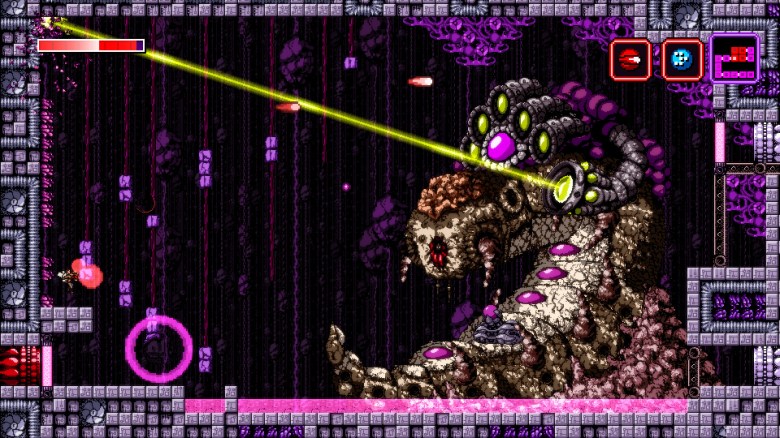
I love how Happ toys with your perception with just the move of the camera. You don’t often see zooming in or out for these types of games, but when I was fast traveling, or going up against a Lovecraftian horror, the camera zooms out to make you tiny, and that makes the world feel even bigger. This led to a different kind of challenge, and made the huge moments feel huge.
Why am I going to complain that this feels too similar to a Metroid game again? I love Metroid games! Sure, instead of a ball you morph into a little critter and sure you get upgrades that are similar to the ones Samus would get. But they’re different enough to give Axiom Verge its own feel. I absolutely adored the reality changing gun, where you spew blue squares in an effort to alter the environment on molecular level to possibly provide new avenues of transportation or exploration. It did mean I got lost a few times, but I also got lost on purpose. I wanted to be swept away by this bloody, puss-filled, disgusting alien world.
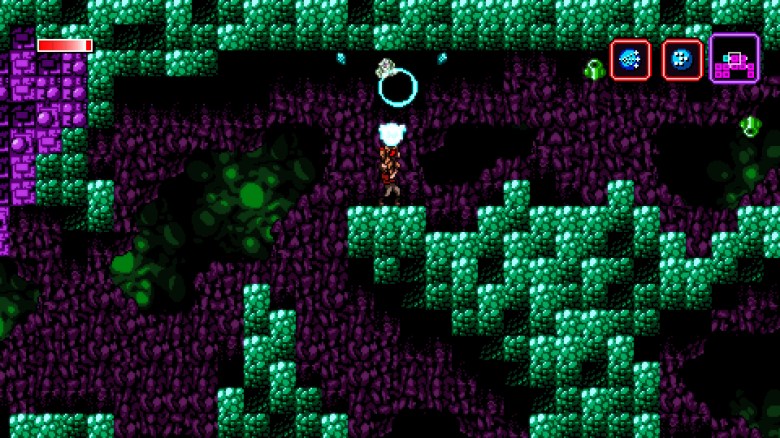
There isn’t a single spell cast by Axiom Verge that didn’t work on me. There were power ups everywhere, which meant I wanted to scan every inch of every stage. Combat was exciting, enemies were unpredictable and aggressive. Weapons didn’t feel like standard weapons, so I had to learn how to use the lightning gun, or the green shotgun. Like all the best Metroidvanias, traversal improves. The progression from being terrified of every living thing to being a Godless killing machine who can zoom through every area without blinking is the ultimate goal of every Metroidvania, or at least it should be. One of the main reasons I dropped off Environmental Station Alpha was because traveling from room to room got more difficult as the game went on. I’m also fine with retro graphics (obviously), but I have my limits. Axiom Verge may not look like a modern game, but I sure could tell what everything was. And I still think it looks great, nine years later.
NINE YEARS. Barf, I have to finish this blog soon. But you know, for a game like this, it could be fifty years later and I’m still going to enjoy it. While I don’t usually find story to be an important element for my own enjoyment, I will admit both Ori games and Axiom Verge’s narrative did add another cherry on top of a beautiful sundae I was already halfway through scarfing down. Reading mysterious journal entries and piecing together what happened was addicting. I have to get to the end, I just have to.
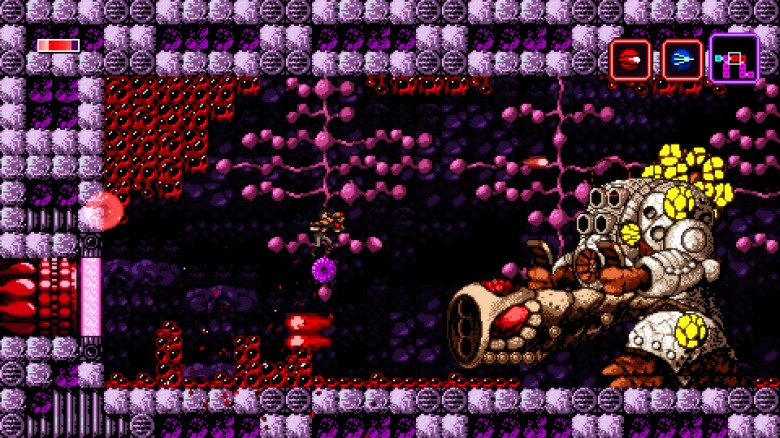
The foundation may be built on a simple premise, and I’m sure there are players who would get frustrated or bored with this style of gameplay, but I’m not one of them. I’d play ten Axiom Verges if they were available, though I will concede Axiom Verge 2 didn’t quite have the same magic. You see a ton of Metroidvanias being released each year, but it’s the kind of genre that isn’t in fashion at the moment. No big budget company would seemingly touch a Metroidvania, ditto for Tower Defense and that’s a goddamn shame because those are two of my favorites. Well, aside from Metroid Dread.
It’s one of the few instances where I bothered to care, or remember, my gameplay stats. 13 hours played, 68% of all Items collected, and 93% of the map uncovered. Don’t let me tell you otherwise, I am insanely tempted to go back and 100% this game and I’m even inclined to start over from the beginning. Another benefit of the Metroidvania is that they never overstay their welcome. Less is more.
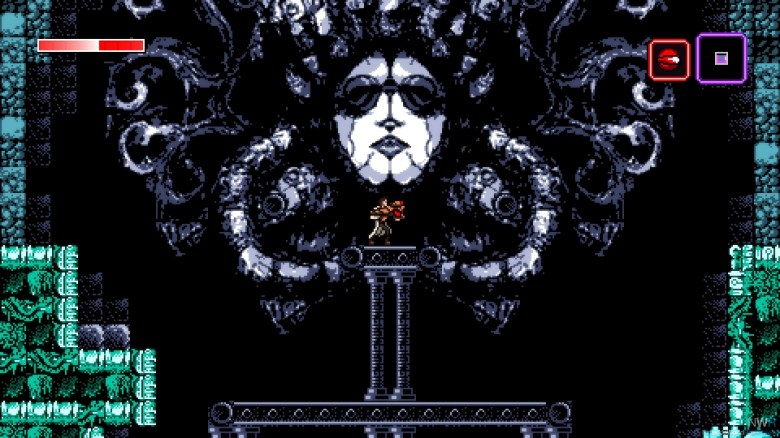
The sense of loneliness, despair and hostility is present on every screen. If you’re going to do an atmospheric tribute to Metroid, which itself is a tribute to the Alien franchise, lean into it. Go all the way. When you collect an item, you don’t just get a congratulation screen, you get indecipherable text flooding your view and a short, punctuated noise confirming you’ve unlocked something incredible. When you get a dash move, you don’t just move quickly, you teleport through things at terrifying speed. Fast travel isn’t just fast travel, you’re hopping a ride on an enormous head through a makeshift highway across the planet. Thomas Happ knew exactly what he was doing – making a game that Henry Skey (and other Metroid fans) would love, and will love, forever.
 The 500