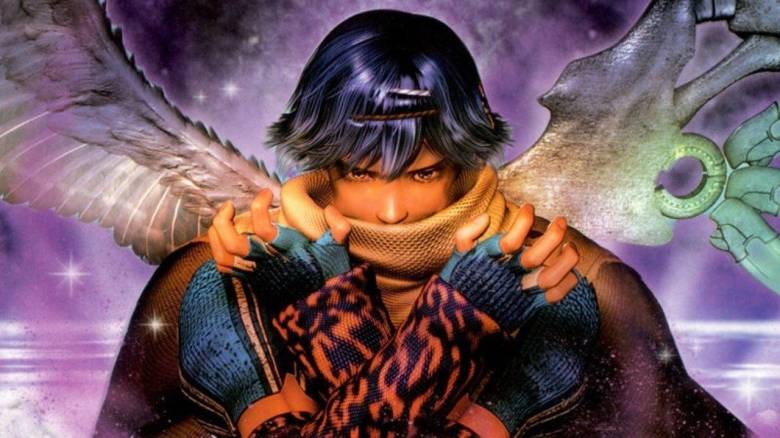
Genre: RPG
Year: 2003
Developed by: Monolith Soft / tri-Crescendo
Published by: Namco
Platforms: GameCube, Switch
#12
Feeling Like: The Deck is Stacked
I saw Baten Kaitos: Eternal Wings and the Lost Ocean in a dorm room in Truman House. It’s since been torn down for a new student center, but I got what I needed out of it in the long run.
I took one look at the case and thought it looked a little silly. Then, I read the synopsis revealed it was a card-based RPG. That immediately turned me off, so I left Baten Kaitos (I’m not typing out the entire title going forward) in the dust and forgot about it.
Something kept drawing me back, however. The reviews were respectable. It had a great look. Fuzz and I were obsessed with RPGs (unlike Truman House, that has not changed) and we had a GameCube. Fuzz and I also didn’t prioritize our studies; I mean, we went to class, we studied together but with nowhere near the amount of fervor we reserved for video games.
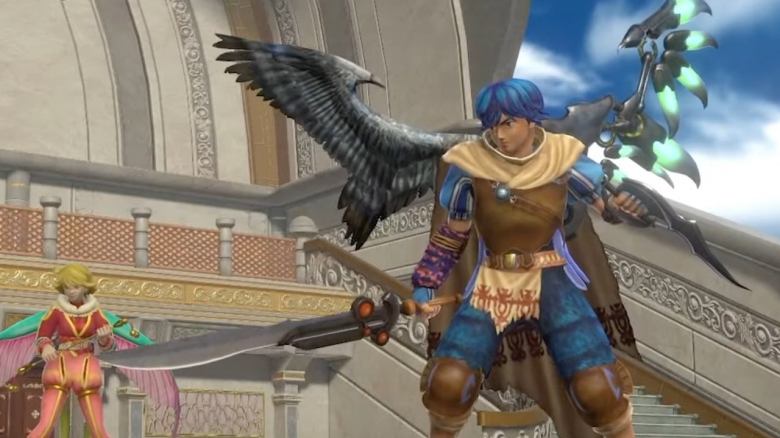
So eventually, I got a copy for very cheap and within 15 minutes, I knew I’d been profoundly stupid in judging a book by its cover. Baten Kaitos, as you can surmise, ended up being one of my all-time favorites.
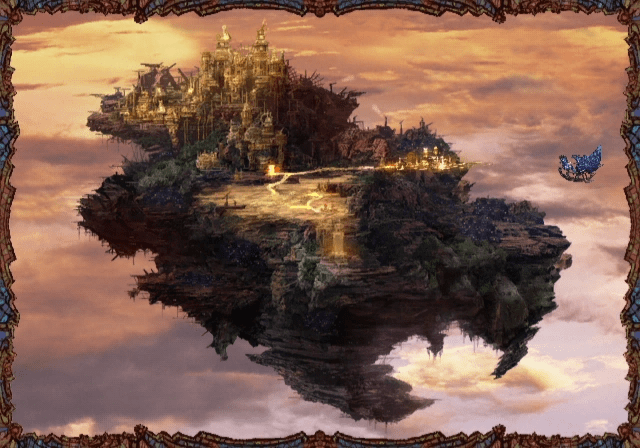
It’s weird, don’t get me wrong. The world takes place in the sky, everybody has wings or wings adjacent. There’s an evil empire that wants to unleash some world-ending threat for more power. Rote stuff, but one of the many clever hooks is how the narrative is structured. Kalas is the main character, but that’s not who you control. You are a “Guardian Spirit”, an invisible force that helps Kalas along in his journey. This distinction is very important, since sometimes you’ll make statements as yourself, and Kalas will converse directly with you. There are some weird fourth wall breaking moments, but because of this system it allows for one of gaming’s greatest twists. Even twenty years later, I won’t dare spoil it. It had me absolutely floored. It’s an awesome, unique system that I rarely see duplicated. Points for Baten Kaitos!

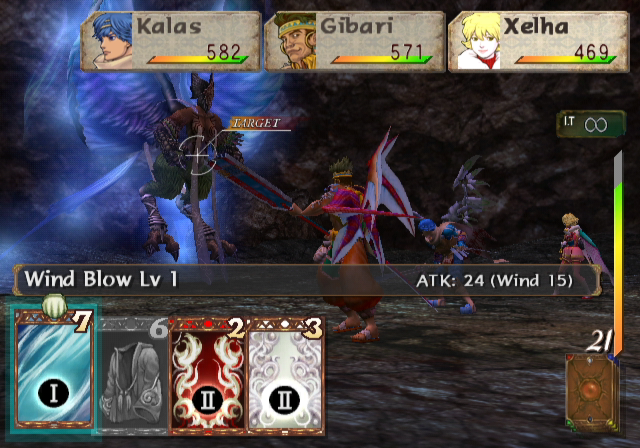
The holy trinity of fundamentals of an RPG, to me anyway, are graphics, music and combat. If you nail all three of those, you’re in good shape and boy, does Baten Kaitos crush these. The combat is entirely unique, thanks to the card system You pick up “Magnus” around the world, which essentially are abilities transformed into cards. There’s not a ton of difference between cards and “just selecting a move on a menu”, but the trick is that your selection of commands are shuffled into a deck and randomly popped out in a row. There is an element of randomness here – sometimes you’ll need a defensive card BADLY and it just won’t appear. Other times, your attack cards will line up perfectly since you gain bonuses on straights (2-3-4, etc.) or the same number of a kind (in the above screenshot, you’d want to select the second sword, then the top left option of the third, then the top right version of the fourth card to get a 3-3-3 bonus).
There’s a very limited time to pull this off, so each turn result in a frantic, almost fighting game combo system. Other cards transform if you continue your chain, further adding to the excitement of every single action. You never really know what’s going to come up and if you’re finding yourself falling in battle, it may just be how you balance your selection of cards. This was my first introduction to “deck building” and now it’s my favorite kind of system in board games. I just played a round of Dominion last night with Kyla and Roger. I lost, as per usual, and there wasn’t any flashy attack animations or brilliant colors, but it’s still a hell of a good time. I have Baten Kaitos to thank for that.
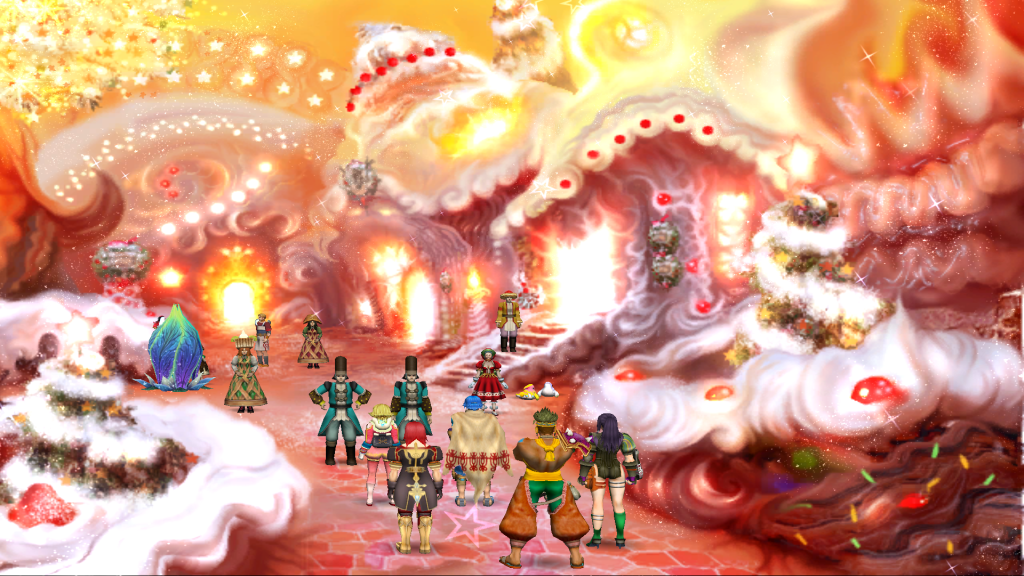
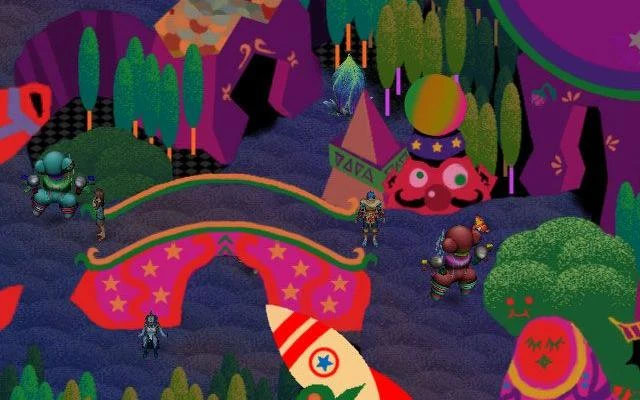
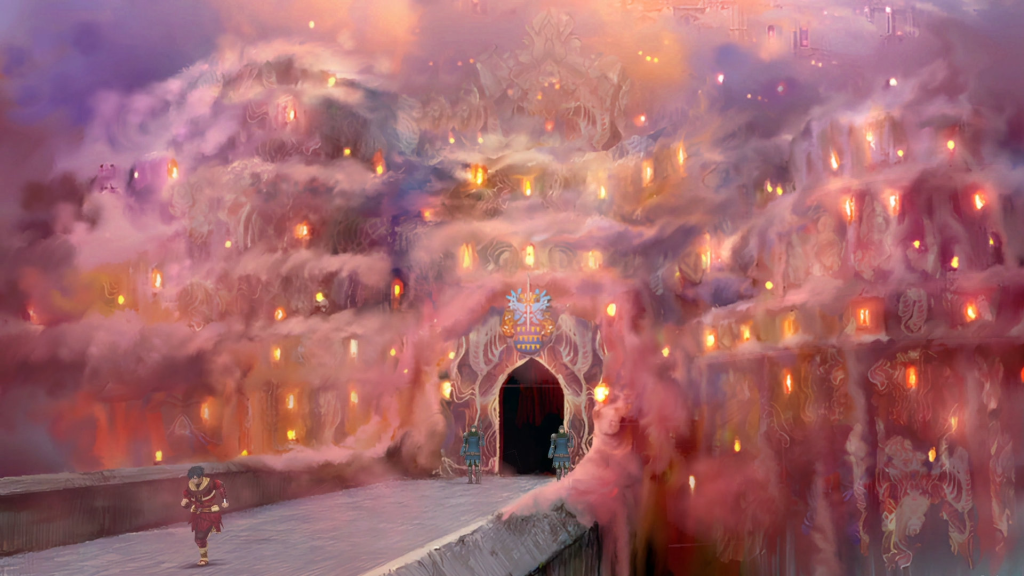
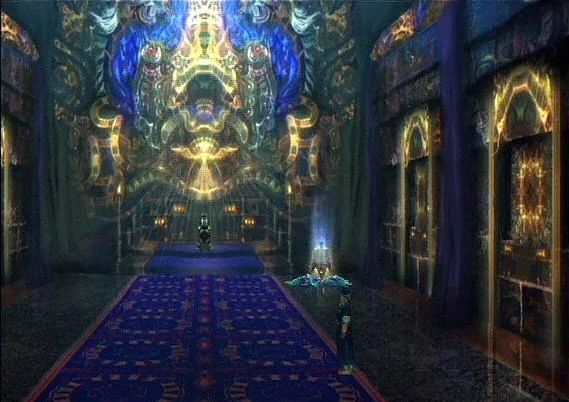
The graphics and music are incredible, even for a game that’s twenty years old. The star of the show are the pre-rendered backgrounds. Not everybody will find this style endearing, but we sure as hell did. There are some sections where colorful clouds are sweeping across the screen, or an entire village is made of delicious looking confections. Every village and location was interesting and fun to explore. I’ve never gotten over it.
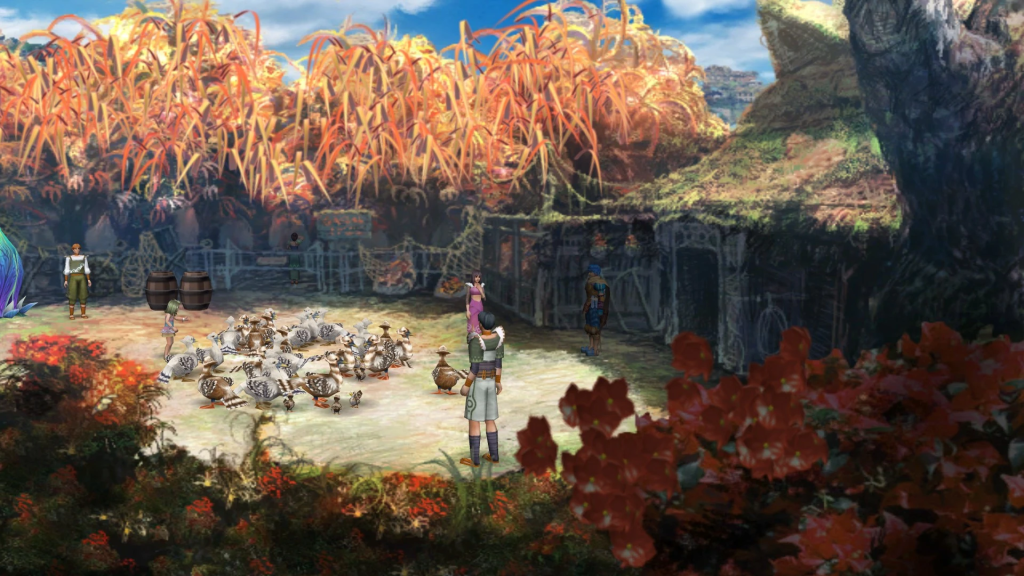
The associated music is brilliant, one of the most underrated soundtracks out there. Just look at the above village screenshot and listen to this. If you’re not relaxed in three seconds, consult a doctor.
I’ve heard a lot of acoustic guitar themes in my day, but “Gentle Wind” may be my favorite.
“Flowing Through the Rays of the Morning Sun” makes me want to go out into the sunshine and explore a new city.
One of the most unforgettable tracks has to be “Castle in the Sand.” I’ve never heard anything like it, the atmosphere it provides when you party goes to a strange land is unbeatable.
Baten Kaitos has one of those musical selections that warrants posting the entire soundtrack and using that as the sole justification for its placement on the 500. Seemingly every instrument is used, from harps, to violins, to pianos, to electric guitars. There are cheesy pop sounding songs, gorgeous sweeping melodies and heart-thumping bangers for when the action is picking up. It is varied and astounding.
It is a long game, as most JRPGs are. You’re not supposed to beat it in a few days, it’s supposed to take over your free time for a few months. When I needed a pick me up, or a boost or just somebody to discuss the happenings of the plot with, I could always count on Fuzzy.
I’ve mentioned him a few times on the 500 – how could I not? I’m confident I spent at least twice as much time at Mount Allison playing video games as going to class, or studying. Fuzz was the same, and he was eager to try any game out and I mean ANY game. Being weird, or labyrinthian, or obtuse was not a deterrent for him. He introduced me to speed runs, back when that community was just starting to emerge. I can’t imagine a Baten Kaitos post without him. Here’s what he says about it.

(Fuzz)
Baten Kaitos: Game is always gonna have some fonder memories because of the social aspect of playing together. Reacting together and talking about thoughts of the game with another person as it happens is probably going to give it fonder memories than a game you experienced alone.
Combat: It was a very good experimental RPG. Timed hits and QTE event’s had already been in RPG’s, deck building games had been around for over a decade at that point, and Baten Kaitos combined both in a rather enjoyable way. Make your deck, armor, healing, the god damn camera, and then in combat, using a short amount of time, get bonuses by matching or sequencing numbers? It was’t overly demanding, but it was creative and fun. Especially since using some cards sequentially would create new combo cards (According to game FAQs, 141 of them).
Music wise, it’s Motoi Sakuraba. You can probably hear a couple strings of any of his songs, and immediately recognize his style even now, but he’s been around a long time for a reason. “Chaotic Dance” in particular still stands out in my opinion.
Characters, none really feel exceptional, going back through memory. The story is fun, everyone more or less makes sense. There’s even a redhead who sucks and blows (his specialty is instruments). Simple memory, Kalas, Xelha and Mizuti, the main 2 and the weird masked mage are easiest to remember. Also memory unlock, we immediately turned off voice acting, although it may not be that bad? Bad guys motivation seems at least consistent, plenty of colourful characters to engage in.
Gameplay: Already covered combat, how about the worlds? All colourful and unique. Using even more special cards than combat cards, you can get essences of rain, apple, shampoo, emotions like doubt, to solve puzzles and side quests, and some of them had fairly short timer countdowns till they turned into something less useful, or not at all useful for the puzzle you were trying to solve. Getting more cards made some puzzles easier, and others weren’t solvable without finding all of the other cards.
Story: Well, it still has one of my favourite twists. Not everyone going to like it, and it more or less follows RPG tropes without too much going off the rails. Evil emperor, severe inequality, environmental disaster, magical villages hidden, trying to destroy the world to reform it… All are present. It’s not going to shake the foundations of storytelling. But the twist still makes me smile how they pulled it off and the hints along the way. The story probably doesn’t hold up too well to scrutiny if you want an absolutely flawless story, but it’s fun, it’s tropey, and it’s from 2003 where the tropes were barely 10 years old compared to a modern tropey story where the tropes are old enough to have baby tropes.
In short: It’s a good game. Very worth the play if you like RPGs. Your only hesitation to play is “I hate RPGs”,” or, “I cannot handle quick number selection for combos”. You can probably beat the game without getting number bonuses, but it sure would make the game harder. Almost certainly not going to be your favourite RPG of all time, but part of me is glad it’s remade for other players to have more motivation to give it a shot again.
Also, Henry: You wanted rambling, you got rambling.
(Fuzz’s writeup finished)
No, you’re not going to find out what Fuzzy’s real name is because I don’t recognize him as that name. He’s always been Fuzz. We were fast friends in first year of University and we stayed that way. Our penchant for gaming and being patient with each other resulted in one of my best friends always being by my side. It didn’t matter if it was a twitch style arcade game, or an 80 hour RPG, we were going to beat it together. We occasionally snipped at each other, but never over anything serious and we certainly never fought over the controller. With a game like Baten Kaitos, sometimes it’s nice to just sit back and watch. Fuzz was determined to discover every Magnus card, regardless of the ludicrous requirements at times. I was determined to giggle at his attempts, though I ended up admiring his tenacity.
There are so many weird touches found in Baten Kaitos, but it seemed like they were specifically designed for me. The menus look like a coloring book, the progress bars are essentially rainbows. Every button confirmation, every purchase from a store, every conversation with an NPC felt right. You don’t progress in the traditional way: you “bank” experience points and level up at designated blue save flowers. For some, this is a maddening decision. For me, as somebody who almost always benefits from delayed gratification, this was a Godsend. I seriously loved the anticipation of storing more and more EXP, wondering how many levels at once I’d gain for each of my party members. The progression of power would then be evident in the next fight. Gaining one level won’t do much, but gaining five or six levels? I noticed a difference, big time. Transporting to the level-up church provided a strong Pavlovian response, every time.
It’s not going to wow you if you’re not into these types of games. There’s no crossover appeal – you’ll find yourself in fights hundreds of times and if you’re not excited about the notion of turn based combat, there’s nothing for you here. The voice acting is embarrassing at times, but mercifully you can turn it off. The overarching plot isn’t anything you haven’t seen before, and I wouldn’t proclaim any of the individual characters as standouts.
But the novelty of the Magnus system, both in and out of combat, made up for any shortcomings. Even if an NPC gave you something as wimpy as a banana card, it could could be used to heal you, or to start a side quest, or you might trade it in for something more valuable. There was always something to explore, or cards to add to your deck. Because you need a hefty amount of Magnus to withstand tougher enemies, every treasure chest contained some kind of improvement over your existing deck, even if it was a minor one.
It’s one of my favorite JRPGs, though it wouldn’t be nearly this high without Fuzz.
 The 500