
Genre: First Person Shooter
Year: 2013
Developed by: Irrational Games
Published by: 2K
Platforms: PC, PS3, XBOX 360, OS X, Linux
#74
Feeling Like: Steampunk Cloud Nine
I’ve reached the first BioShock game on the 500, which means we are really cooking with gas now. Only three sections to go and 74 more entries before I actually complete this project. Even the notion is mildly insane to me; the fact that I still have a long way to go is both discouraging and encouraging at the same time.
The burden is eased since every additional post means the games are getting better, which means (in theory) they’re easier to write about. All three BioShocks are among my favorites and it’s a painful reminder that we haven’t had a mainline BioShock game in 10 years. I wish they’d come back, as when it comes to narrative-focused first person shooters, there are few that do it as well as a BioShock.
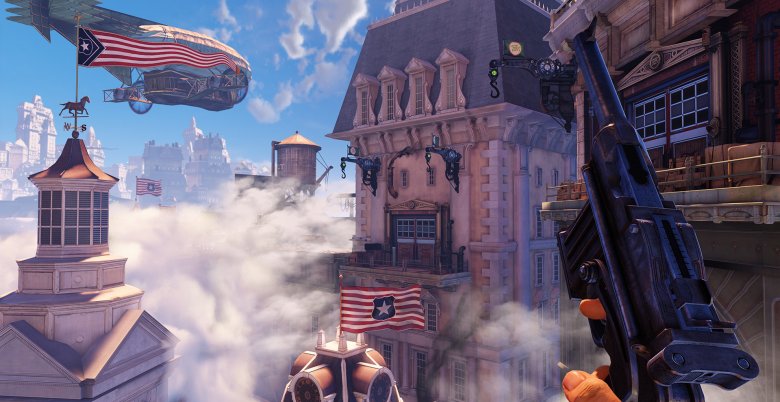
There are dozens of YouTube essays and articles about why BioShock Infinite fails, but I’m not even going to acknowledge those. I don’t get the criticism, but do understand when a studio swings this hard on a story that revolves around themes like slavery, philosophy, psychology, economic disparity, capitalism and freedom, they’re going to hit some nerves. The spectacle is outlandish, the environment is unforgettable and I fell in love with the characters. It’s the kind of game where I felt like anything could happen, and it often did. BioShock Infinite is an amazing, thoroughly enchanting experience.
I can’t help but get swept away by the graphics. Everything is intricately designed, wonderfully so. There aren’t any boring areas. The people look like a bit like mannequins, but the atmosphere is going for a demented fairy tale anyway so it totally worked for me. I wanted to look at every facial model, watch every animation of the citizens of Columbia. Much like how Rapture was a compelling city to explore in BioShock, BioShock Infinite’s setting grabbed my attention within seconds of touching down. Location, location.

It’s not easy to capture the feelings of a period piece/utopia/science fiction story, particularly where you have to slowly reveal that (gasp!) it’s far more dystopian than at first glance, but Irrational Games managed to do so beautifully. For every rich snob who preaches the truth of Columbia, there’s a downtrodden, poverty stricken worker who is desperate for change. Every new area is fed with an ongoing story beat, further motivating me forward. It’s an amazing example of video game design and I’m not sure we’ve seen anything like it since. Come back, BioShock!
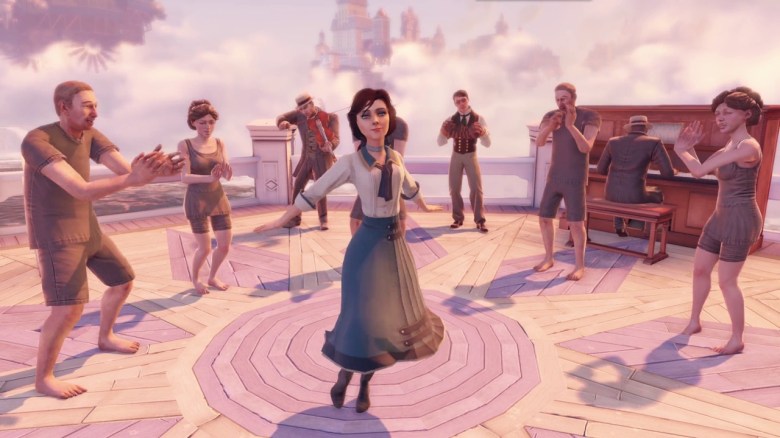
Elizabeth is, and was, one gaming’s best companions. Any complaints about escort missions were tossed aside when I realized she can’t be hurt by me, she never gets in the way AND she’ll toss me useful items, sometimes right in the middle of a firefight. Booker, catch! Much obliged!

Honestly, even looking at the above screenshot makes me irrationally angry – how could a game made ten years ago look this good? Where are all the BioShock Infinite copycats? Courtnee Draper does an incredible job voice acting Elizabeth, she goes beyond a brainless NPC you have to keep safe. She has her own feelings on the happenings, the revolution, even Booker himself. She’s the star of the show, rightfully so.
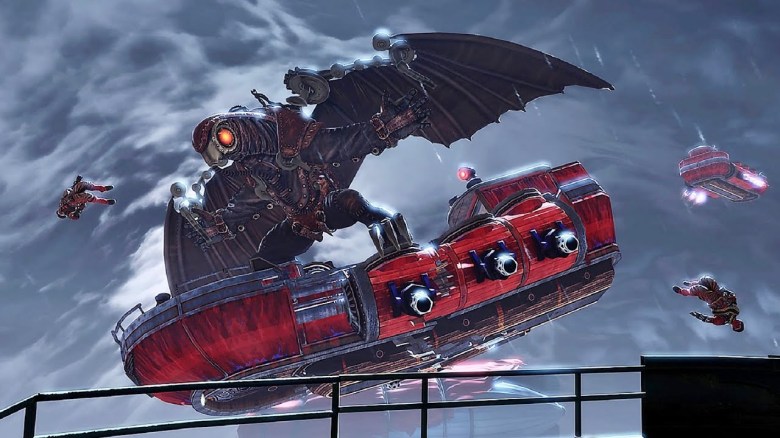
Combat was a thrill, every time. You could use a hook to traverse the aerial rails, so it frequently felt like I was a gun-toting, magic using rollercoaster. The combination of guns and powers felt like a refreshing take from the traditional BioShock weaponry. Enemies are unique and strange. Their faction is overwhelming nationalistic, and are obsessed with the founding fathers and bold proclamations about how humanity should live. So, naturally, you’ll be fighting robots that look like George Washington.
The soundtrack is as good as the level design and characters. Just look at the first part of the game, how good is this? When I saw Commish Mark perform in Ring of Fire at the Chemainus Theatre and one of the songs they sang was “Will the Circle Be Unbroken”, I nearly broke into tears. It’s a powerful song, and even though I’m not a religious man, I can feel the spirituality when I listen to it. The stained glass windows, the glittering water, the soft candles all emit a mood that few games ever come close to repeating.
Elizabeth’s theme isn’t bad either.
I don’t think they quite nail the landing they were going for. There’s a bit too much of “both sides” and the big twist wasn’t exactly difficult to see coming. That being said, the set pieces involving the factions, the mechanical songbird and flashbacks to Rapture are incredibly moving. The game never overstays its welcome, I could have easily finished the entire thing in one or two sittings. It was the kind of experience that I forced myself to continue unveiling, until my eyelids could take no more. The intricate design, masterful narrative and one of the best companions in gaming meant BioShock Infinite was a privilege to play through. Columbia is an appealing juxtaposition to Rapture, not only because it’s in the sky instead of under the sea, but because we see what Rapture was ideally supposed to be – a paradise, filled with happy denizens who believe in a cause. It makes peeling back the curtain and finding the faults in it that much more tragic.
And it’s my least favorite BioShock. Imagine that, what a series!
 The 500