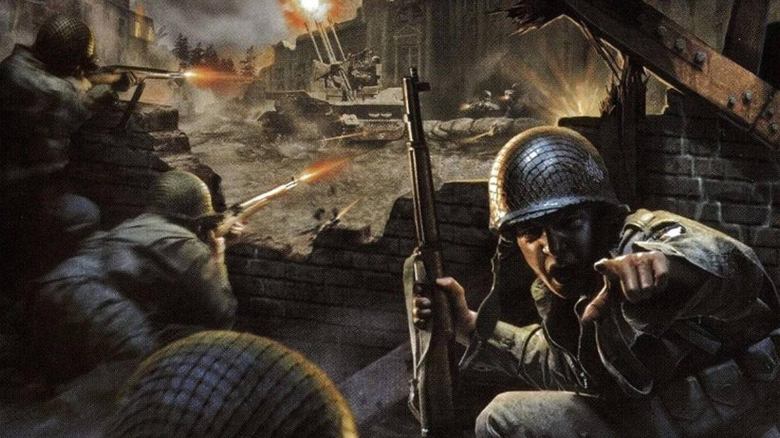
Genre: First Person Shooter
Year: 2003
Developed by: Infinity Ward
Published by: Activision
Platforms: PC, Mac, PS3, XBOX 360
#123
Feeling Like: Heeding the call
Out of the remaining 123 games on the 500, Call of Duty may be the one I’m least certain about. Not its placement, for the fading memories are strong enough to remember the incredible set pieces and thrilling action. But I just don’t know what to say, or how to come to terms with my own feelings about re-creating wars that actually happened.
This was the start of the Call of Duty franchise, one that would go on to be one of the most commercial successful properties ever. Aside from a two year gap between Call of Duty and Call of Duty 2, there has been a Call of Duty launched every year for the past 20 years. I’ve only played three of them, this one and the two Modern Warfares. I’ve enjoyed all three and have more solid memories of Modern Warfare and Modern Warfare 2, but Call of Duty itself…as a fair weather Call of Duty fan, I’m ill equipped to do my usual shtick here.

I can’t talk about the nuance or improvements from game to game, or look back fondly on epic multiplayer matches – the LAN parties I went to were always Battlefield focused. But looking back, you can see why Call of Duty endured while other hopeful attempts faded.
Halo: Combat Evolved showed the desire for players to feel like they were a part of something, that they had allies fighting alongside them and were a part of something terrible, and grand. Hardware limitations hindered that in previous years, but going forward developers could really toy around with scripted sequences that would feel spontaneous and horrific.
The Russian soldiers (pictured above) being shipped to certain doom is one of the game’s most harrowing scenarios. You see transport ships next to you get blown out of the water by the Luftwaffe. Your fellow Russian soldiers threaten to kill you if you desert, but where would you run to, exactly? It borrows heavily from the movie Enemy at the Gates, but Stalingrad was so brutal it warrants multiple artistic interpretation.
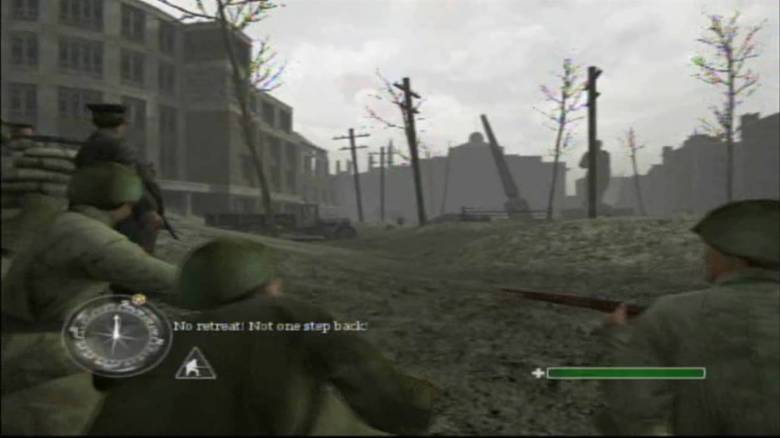
You really are part of a unit – there’s constant chatter from your comrades, as well as radio chatter from your Commanders. It’s rarely clean, everybody is shouting and explosions will often punctuate a climactic moment. The spectacle is the star of the show here and even 20 years later, it’s impossible not to feel something when completing a particularly difficult section.
I feel my opinion on history and war evolves as I get older, I’ve spoken with Scott about this many times. While we both loved watching every war movie we could get our hands on in high school, later on in life I started to feel a bit uncomfortable with the whole idea. The details were, and still are, fascinating to me; the logistics, the individual stories, the strategy, the political fallout, the economic impact and the civilian outlook are so multi-faceted that it’s no wonder why media and art have covered this topic perhaps more than any other.
But I don’t know if I should be interested, or excited, to learn about the hell these people went through. It’s a failure of humanity and the more closely I studied, the more squeamish I became. Tim Cook’s double volume about Canadian soldiers in World War 1 (At the Sharp End, Shock Troops) was a sobering portrait of how young the soldiers were, how they volunteered in droves, lied about their age so they could get a chance to serve their country. The image of them lining up to be processed on Wharf Street at a building I’ve passed a hundred times was an emotional gut punch.
I don’t know if I’ll ever come to any kind of conclusion; I still enjoy shooters, I still enjoy the digital recreation of being put into somebody else’s unlucky shoes, I think Band of Brothers is one of the finest pieces of television ever made and books like City of Thieves, or The Good War by Studs Terkel have permanent residency on my bookshelf. I like learning about history, Mr. Stanley made sure of that. It just so happens that much of history is bloody.
I never thought about this while playing Call of Duty, that much I do know, but maybe that’s why I’ve avoided most of the series? I can handle the odd dip into the Modern Warfare pool, but the one-entry-a-year always puts me off, particularly if the games are at full price.
Still, the mix of British, American and Soviet campaigns allows you to star on many stages in the theatre of World War 2. It was impossible not to be awed at the scale of destruction and to feel like you were a small part in a massive conflict, rather than everything centered around you. It’s at #123 for a reason, and there are more Call of Duty games to come, but the lingering unease about why I enjoy learning and experiencing this type of realistic violence still simmers.
 The 500