Genre: First Person Shooter
Year: 2007
Developed by: Infinity Ward
Published by: Activision
Platforms: PC, PS3, XBOX 360, Mac, Wii
#110
Feeling Like: Sweet and Sour
I rarely see Call of Duty 4: Modern Warfare listed among gaming’s most influential titles, but it probably should be. It wasn’t the first Call of Duty, it wasn’t even the first one on the PS3/XBOX 360, but it was an obvious landmark in the franchise and for first person shooters in general. My God, what a year 2007 was! Never mind games like Mass Effect, Super Mario Galaxy or Rock Band. For first person shooters alone, this has to be the single best year, ever. BioShock, Halo 3, Crysis, Portal, Metroid Prime 3: Corruption, Half life 2: Episode Two and Call of Duty 4. Talk about a murderer’s row.
I know the multiplayer is what sold it, but I never touched it. Out of all the categories of games I enjoy, I’m least adept at shooting. Can’t do it. Josh, Mitch and Jose’s saintly patience while I tried to play PUBG with them deserves a Nobel peace prize. I thought I was good at Unreal Tournament, until I literally played against any other human.
What I came for was the single player campaign; a short, Michael Bay-esque spectacle that is rampant with unforgettable moments amidst an updated setting. While I was floored enough to beat the entire game within a single sitting, the current events of the Middle East and Ukraine/Russia lead me to hesitate saying how much “fun” I would have playing a Call of Duty today.
Since I’m nowhere near qualified to speak about true terrors, I’ll focus on the game as a game. Only a select few that I’ve played are even interested in asking the player questions about WHY they enjoy participation in modern war simulators anyway, but we’ll get to Spec Ops: The Line one day.
While the campaign is rife with intense moments and fantastic set pieces, there are two that stand above.
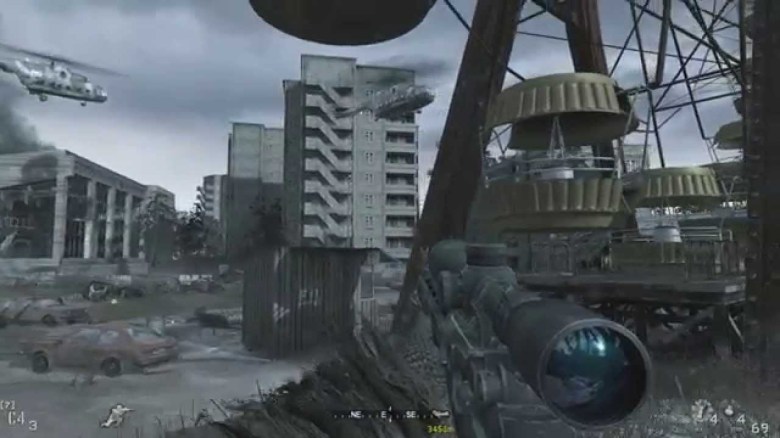
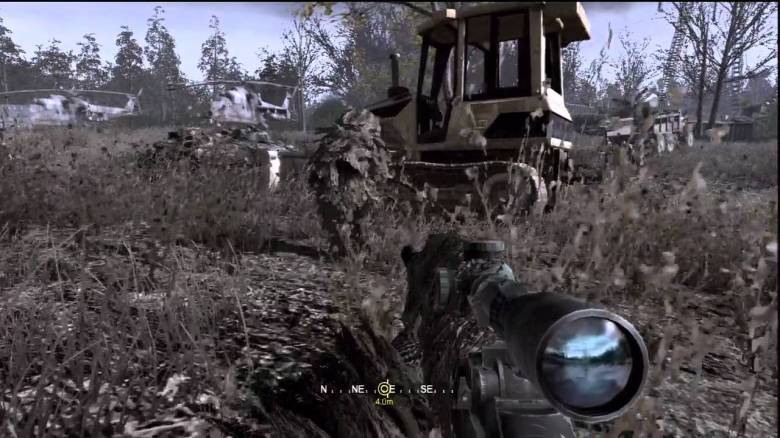
The Pripyat mission is one of the most memorable in gaming. It’s one of the best examples of stealth I can think of and, yes, that’s two games in a row where I praise stealth mechanics. You and Captain MacMillan are shrouded in heavy camouflage and have to infiltrate the abandoned village surrounding the Chernobyl Power Plant. “All Ghillied Up” is incredibly immersive, as long as you’re ok with following orders and going along a linear path. I like being told what to do, so when the Captain told me to “hold up” or “wait for me to get into position before firing” or NOT to engage enemies at all, I listened and obeyed. I loved it. I know it’s not exactly the most free in terms of player choice, but I choose to enjoy myself since the threat of being spotted and hearing radiation clicks more than made up for any shortcomings. Crawling under giant trucks while you can see and hear your enemies right beside you was a thrill. I’ll never forget it.
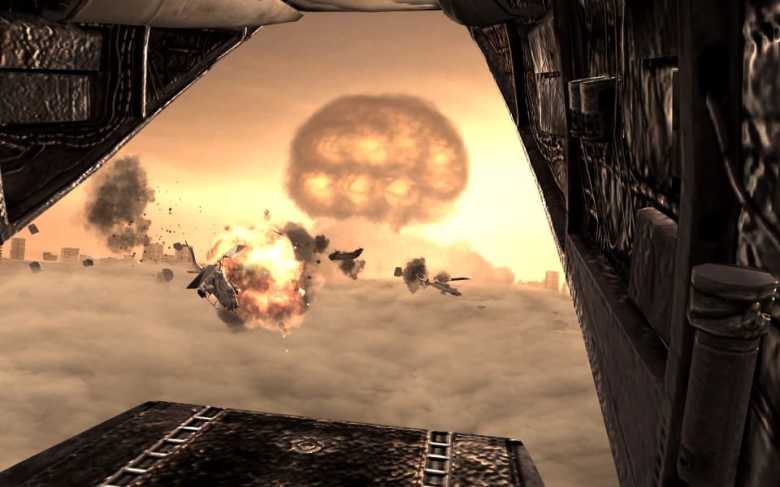
The second scene involves a nuclear explosion. In this mission you’re playing as Sergeant Paul Jackson with the American army. After an exciting level in a city located in the Middle East, you hop onto a helicopter and start flying away. It’s all done in real-time, and it’s evident that the production values are sky high. I could feel the heat and the sand on my fingers as I sprinted to apparent safety. Then, over the radio, a confirmation of a nuke has been identified and BOOM. It goes off.
Hollers are quickly silenced, as the blast engulfs the other helicopters you can see, until you go down as well. There’s an effective scene with audio from news coverage in the background, confirming the explosion. Then, in a harrowing moment, you’re given control of Sgt Jackson one last time as you crawl out of your disintegrated aircraft and then it fades to black. A zoomed out map with flashy writing confirms that you were killed in action.
Whoa.
It reminded me of when Steven Seagal’s character dies in Executive Decision, early in the film. It was a total shock, Seagal infamously wanted all the spotlight and generally his movies were all about him. Ironically, that’s probably his best movie and role – what a badass way to go out. With the nuke scene in Call of Duty 4, it was if the developers were saying to me ok – you’ll never know if you’re safe. Because we switch around the protagonists, we have the ultimate freedom to play with the narrative. Games can induce a sense of danger, but the Game Over screen will lead to a respawn. Here, Sgt. Jackson is gone. Going forward, I never knew what to expect in a Call of Duty campaign.
Ok, it’s not as if the character had any depth to begin with, but I still love the gruesome surprise. A nuclear weapon going off is as unsettling today as it was in 2007, or during the Cold War. The biggest deterrent is knowing that the other side will retaliate in case somebody gets squirrely and actually wants to use them…but who does that help once the button has been pushed? Mutually assured destruction is terrifying, and it’s used to great effect here.
The rest of the scenarios were varied and exciting. Rescuing a downed pilot, or providing air support or shooting from the back of a moving vehicle seem rote these days, but in 2007 we were really seeing developers take chances and risks with first person shooters. The original Half-Life showed that you could incorporate storytelling without interruptions or cut-scenes, but by the time 2007 rolled around we saw that improved hardware and larger budgets could yield high quality moments. Bullets whizzing by and your companions screaming in your ear wasn’t new, but it sure felt more real than ever before.
I’ll never complain that a campaign is too short. Because the intensity is dialed up to 11 here, I think it was a wise move to keep the campaign to roughly four or five hours. That being said, there’s still 21 missions and a massive multiplayer section (at least then, the servers are dead now from what I hear). It’s rare that a Call of Duty goes on sale, but if future iterations are anything like this and Modern Warfare 2, I should probably keep an eye open.
 The 500