
Genre: Action-Adventure
Year: 2010
Developed by: Ninja Theory
Published by: Namco Bandai Games
Platforms: PS3, XBOX 360, PC
#92
Feeling Like: Monkey see, Monkey do
Enslaved is one of those games that grows in affinity, though I imagine the game itself is the opposite. In my Serotonin article I wrote for Snackbar, I praise the visuals for how “real” looking the character’s faces are. I will admit, they still look pretty good but compared to future titans like The Last of Us Part 2 or Uncharted 4: A Thief’s End, they’re a generation behind.
I imagine controls aren’t as snappy, combat isn’t as fluid and once you experience something like Horizon Zero Dawn or God of War, it would be difficult to go backwards in terms of third person action design.
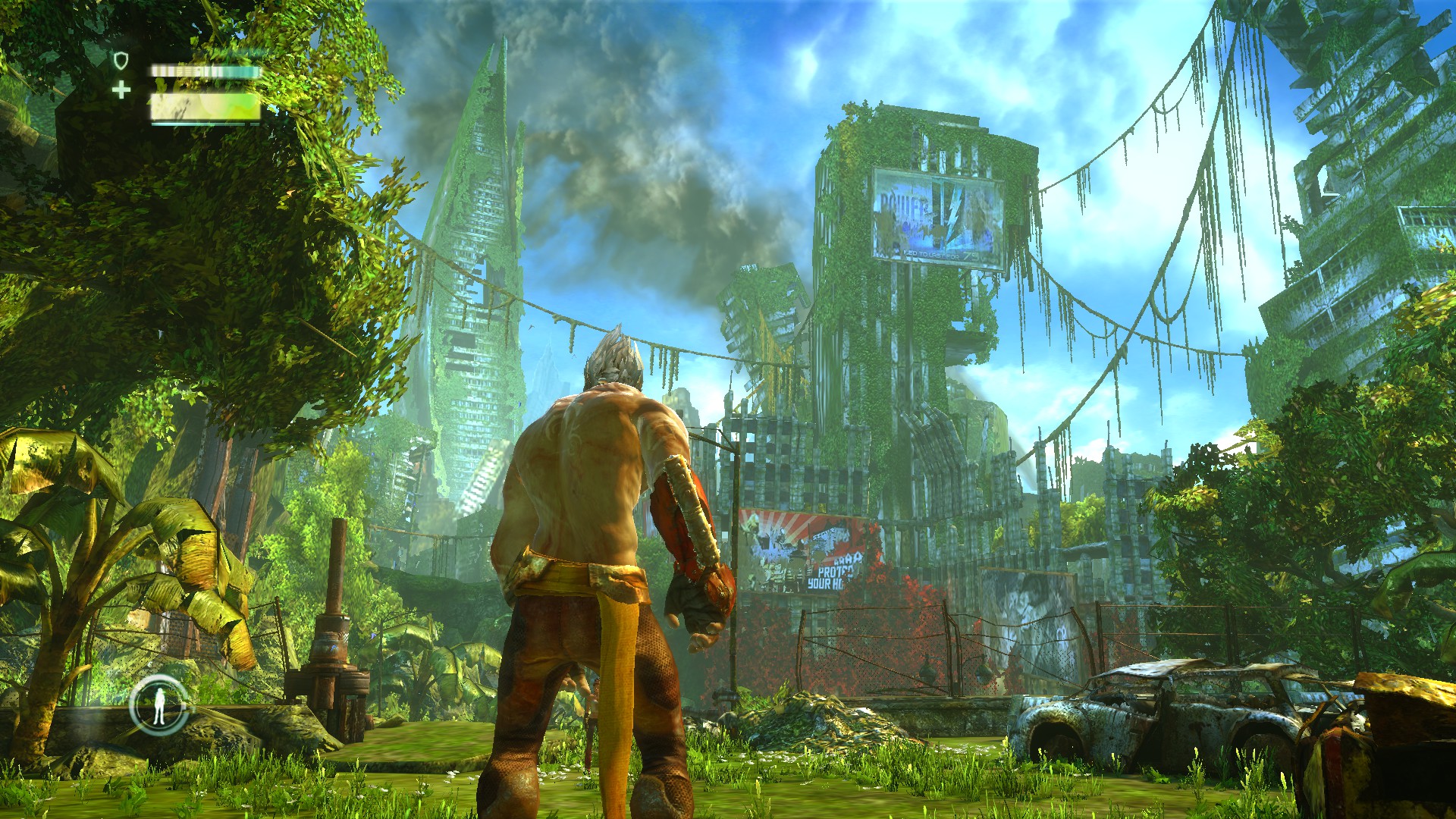
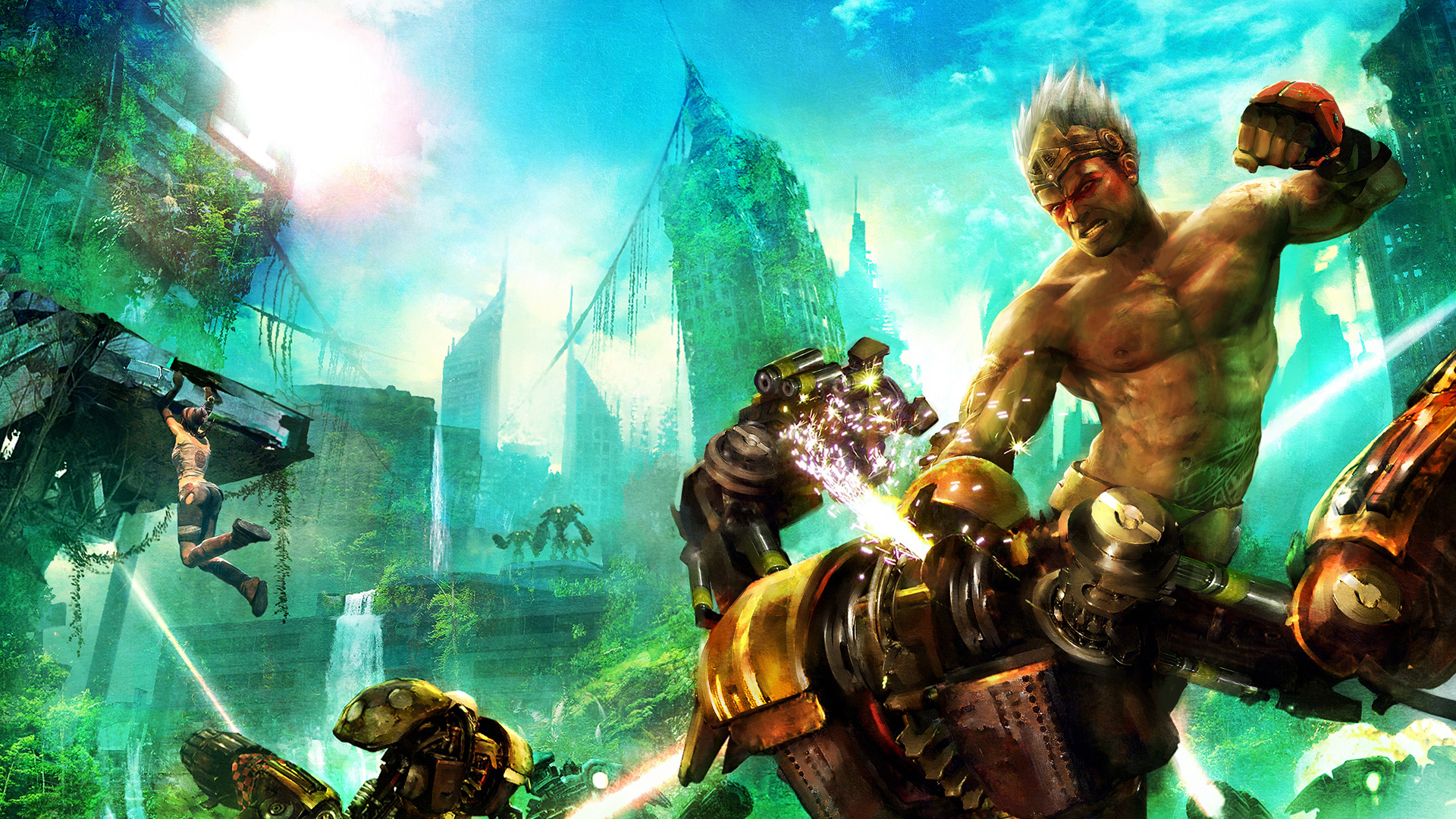
Getting older combined with playing an unhealthy amount of video games means I forget most of the minutia of a video game. Often times I won’t remember the abilities you use, or levels you inhabit. It’s strange, you’d think I would recall what I spent the majority of my time doing in a game, like moving or fighting, but that’s not usually the case. I can’t help what does last in my head and what doesn’t. Even if I spend 100 hours on something, it’s usually one or two big moments that stand out. It’s not very fair to the developers, but again, I can’t help it.
What stands out to me about Enslaved are the actors. Or rather, the motion capture used to great effect and the decision to have Andy Serkis as Monkey and a real life Andy Serkis play the end villain. Upgrades you gain? No idea. Platforming sections? I’m sure they were fine, but that’s not why Enslaved is way up at spot #92. Combat? I hear it gets repetitive, but I can only shrug.
I’ll let Henry of the past discuss why Enslaved resonated with me then, and now.
Released in late 2010 for the Xbox 360, this action game went under the radar for most. The first thing I noticed about Enslaved was the graphics. The game looked good; smooth animations in battle, lush areas of a weird, post-apocalyptic world. Sure, it was linear and the combat and platforming were simplistic, but eventually I stopped caring about those factors because I grew to care about Monkey and Trip, the protagonists of the story.
Monkey is a strong, pragmatic, gritty warrior. He is less than pleased to find, upon escaping a prison ship and crash landing, that Trip has placed a slave collar on him. Monkey must obey her every command and if she dies, he dies. So begins the story.

I’m not going to say the game is a transcendent experience. Those with more knowledge of what makes “great” games will surely tell you that the game always reminds you that you’re playing a video game. It doesn’t have a revolutionary gameplay mechanic. You get the feeling you’ve done this before.
What you haven’t seen before, and what I grew to learn to appreciate, is the facial motion capture of Monkey (Andy Serkis, a.k.a. Gollum) and Trip ( Lindsey Shaw). This wasn’t just good voice acting, these sounded like real people who didn’t spout their dialogue like they were throwing up words. They were emoting properly. The facial reactions were uncannily realistic. I identified with both characters and wanted them to succeed. It helped that Trip isn’t a useless A.I. partner always in distress; you will need her help in fights, and she will help you without falling into a chasm (most of the time).
They develop a relationship that is believable in an unbelievable setting. Epic fights with mechanized units and monstrous beasts occur, but the real connection comes from the quiet cutscenes with just Monkey and Trip. Take a look.
See how at 35 seconds, Trip actually looks sad? Not typical video-game sad, where the character would be frowning, or screaming, or crying. No, she looks scared. Visibly, but not over-the-top. She looks real. Now look at Monkey’s reaction to her first words. A subtle eye movement down, then back again. Not an overly-dramatic hug or exclamation of understanding. It looks real. You feel bad for Trip. You like Monkey for staying calm. No big, stupid speeches about how everything is going to be fine or some ridiculous attempt at comedy. This is a detail that only a human actor would know how to emote properly.
Granted, the head movements are a bit jerky and the character designs are Waterworld-esque, but the emotion is there. Watching this cutscene makes me want to play through the game again.
Alex Garland, the writer of Enslaved, deserves some credit. He is adapting a famous Chinese story (Journey to the West) to modern storytelling, in a venue where storytelling hasn’t been very good. Shaw and Serkis also deserve credit, as do the designers for picking seasoned actors. Upon being asked about Enslaved, Serkis had this to say:
“If you don’t feel in the moment of filming that the character is moving you or engaging you or transporting you somewhere, it won’t work. So you take that right into the recording of the dialogue. So it’s about trying to keep that dynamic — that relationship on stage — going, rather than having this scenario that normal games have where you just go to the booth and record your lines.”
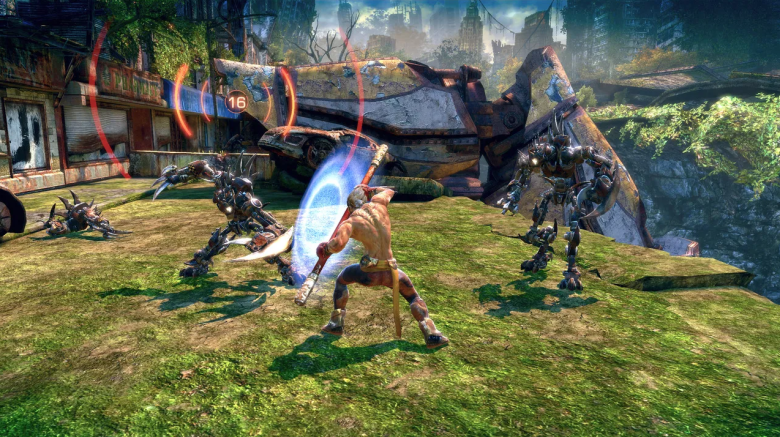
As an actor, one of the best tools you have at your disposal are your fellow actors. Reactions and feeding off the energy of your acting partner can give you an immense boost of confidence, confirmation and emotion. This shows in Enslaved.
The ending of the game has moments of true beauty. It’s somewhat open-ended, but not as open-ended as, say, Halo 2 or Final Fantasy XIII-2. Some would call those endings “not-endings”. As Monkey and Trip, you end up in the fortress housing the main villain, Pyramid. Finally making sense of a series of flashbacks that Monkey saw throughout the game, we see Pyramid is a man. A real man, not a video game model. It’s an actor, with no facial mapping technology, or alien makeup or a mask.
It’s weird at first. You don’t often see real people in a game, but in this context it works. It works oh so well. Then he starts talking to you and you realize… that’s Andy Serkis, in the flesh. Even if you don’t recognize the famous Lord of the Rings actor, you do realize that you’re emotionally connected to this person in more ways than one. A mystery is solved (whose flashbacks were those?). A connection is made: hey, he’s real. A human being, talking to Monkey and Trip, characters I identify with. Is this meta?
Skip to 4:45.
“I have enslaved no one.” Pyramid (Andy Serkis) says after Monkey and Trip confront him, as he sits helpless before them.
Look at the sadness in his eyes. Listen to the sorrow in his voice. You won’t get that from a badly-animated, badly-acted character. You start feeling sorry for him. Him! The main bad guy!
“I am… an ark!”
See that smile? That quick, small smile? We can pick up on that.
“Their children go to schools. You have no schools.”
See the face shrink a tiny bit and Serkis’ voice lower on the “you have no schools” part? A sudden realization of sadness. It’s almost not even there. But because the game decided to use real actors to portray the characters, we see it’s there. We feel.

Using real actors may end up being too expensive. Big-budget games are already bloated as is, and many are predicting an end to these kinds of games. But I hope that the kind of technology that can bring us The Illusive Man, Monkey and Trip becomes cheaper and better. I want more “real actors” portraying my characters. Enslaved: Odyssey to the West certainly benefited from it.
 The 500