Genre: Action-Adventure
Year: 2011
Developed by: Nintendo EAD
Published by: Nintendo
Platforms: Wii
#69
Feeling Like: Skeyword
For a game that got 93% on MetaCritic across 81 critics, it sure does get a lot of hate. If you at all care about specific ratings on the 500, you will probably be quick to point out that A Link to the Past is more than a few spots below Skyward Sword. Wind Waker much lower. But I’m not turning in my Zelda fan card, and I’m not crazy. Skyward Sword has a few annoying bits, but the core gameplay, dungeon design and motion controls felt so incredible to me that I’m still flummoxed as to why hardcore fans seem to scorn it. But it’s my blog, so Skyward Sword gets to be very high up and now you’re going to sit there and read about why.
I’ll get the frustrating parts out of the way first. Skyward Sword does all the minutia poorly. Talking to people takes forever. Buying a single potion from the shop requires something like 10 button presses. Scrolling through text is torturously slow. Fi, the Navi-like companion, never stops offering unhelpful advice. The flying sections are mediocre and aren’t much more than a time waster. So I suppose there is a lot to be angry about, though I would argue these are the appetizers. The main course and dessert are why you come to a restaurant in Hyrule.
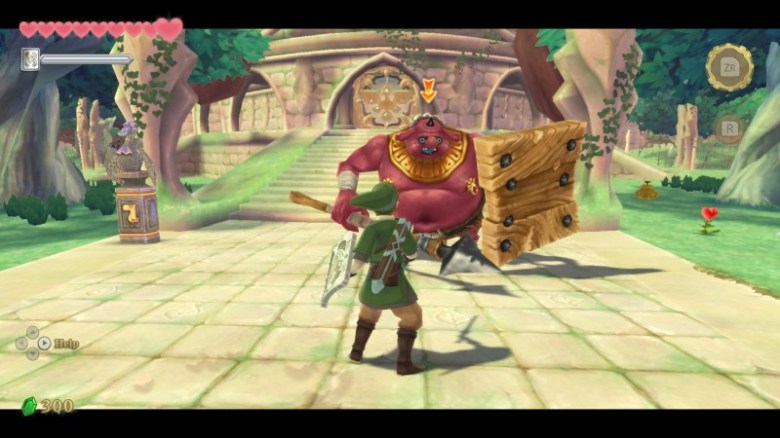
The motion controls may have irked some, but to me they revolutionized the way I approached combat. The nunchuk operated as the shield and the Wiimote served as the sword. With the motion-add on, the Wiimote finally realized it’s potential. Every flick, twist, slice and stab was emulated by Link on the screen nearly flawlessly. This was melded wonderfully into the enemy design, who often held giant obstacles or moved in a way that only a specific angle of attack would work. Every fight felt like a proper duel and instead of devolving into sporadic slashing. I had to analyze an enemy’s defense and strike at right way at the right time in order to inflict damage. This is the only Zelda game where I truly felt like Link himself.
This led to some really creative enemy telegraphs. Oftentimes they would wind up comically slow, opening themselves up but other times they’d turtle themselves in armor, or hide in the sand, or fling projectiles in your way. Reading these moves and reacting accordingly was immensely satisfying. I can’t tell you how great it was to finally land a hit on a boss on the right side after faking them out on the left. I haven’t seen that level of 3D swordplay before, or since. Did I feel silly flailing the Wiimote around? Honesty, not for a single second. Sure, I had to recalibrate the sensor a few times a session but that never bothered me. I’ll take a mild, occasional inconvenience for this level of excellent. Plus, that finishing blow where you thrust both your nunchuk and Wiimote downward, resulting in Link death hopping onto the enemy’s face made me want to stand up and cheer.
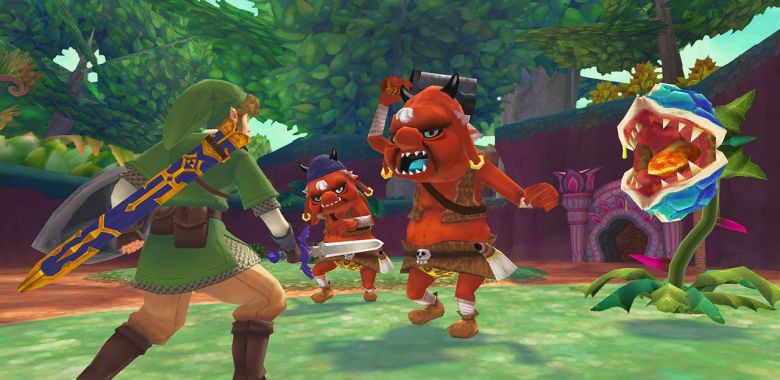
The gadgets and gizmos are among my favorite. The little homing bug was awesome, I loved seeing where I could fly that little guy – usually into a button to open a gate, or smacking a Moblin in the face. The whip, used with a flick of the wrist, is as close as I’ll come to hitting a target with anything that feels like a fishing rod. I loved the Koloktos boss fight where you had to whip his arms off, then use his own enormous scimitar to get past his armor and bash his exposed heart. Going from platform to platform with this thing was something I’d seen done in many games, but always with a button press, never with motion controls. The craze surrounding motion controls has well since died down, but at the time it felt truly fresh. I don’t care if it was a gimmick, attacking and whipping felt better with motion controls than the traditional button push.
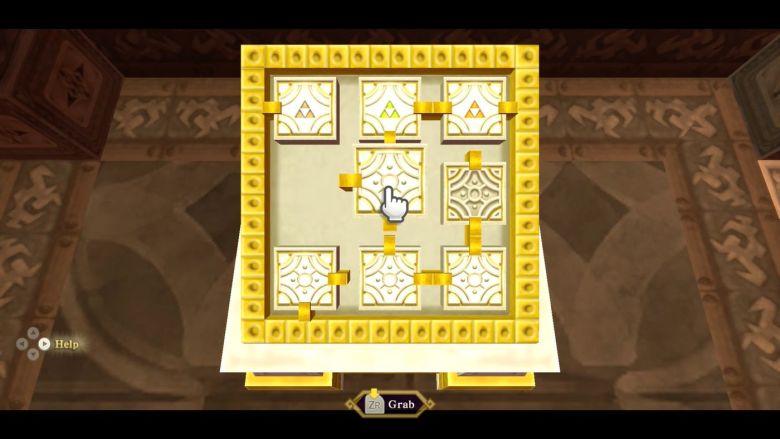
The dungeon design is miraculous, I don’t think they get nearly their due. Whenever I read a “Best of” list of Zelda dungeons, Skyward Sword never gets the love it deserves. Sky Keep in particular isn’t just one of my favorite Zelda dungeons, it’s one of my favorites in gaming altogether. The hook lies in the room construction itself, of which you have control over. In order to progress to certain areas, you have a grid that enables you to move around the rooms themselves. A useless hallway all of a sudden becomes the solution to finding a treasure chest, or making your way to the final boss. It felt endlessly creative and it was something I’d never seen before, at least to this degree. Shifting things around using a device is a staple of Zelda games (and video games in general) but the whole dungeon itself? No way, that is bonkers! Hell yes.
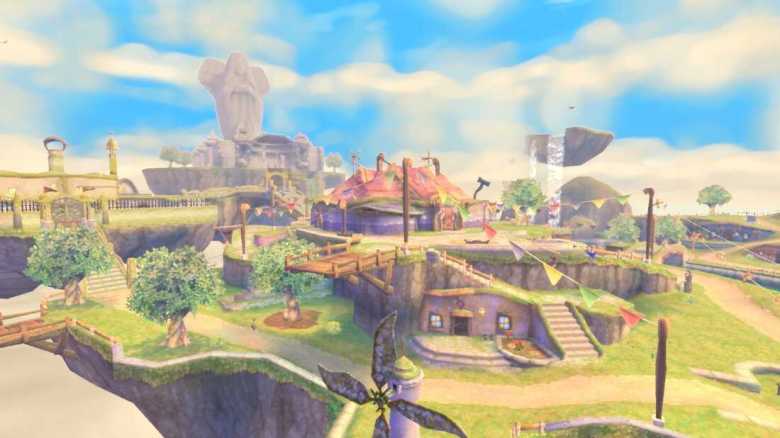
The rest of the game is moderately charming. There’s a far bigger focus on writing, characters and storytelling in Skyward Sword, for better or for worse. Groose, a buffoonish rival, eventually becomes your friend after helping you defeat the Imprisoned, a recurring boss made of spikes and teeth. Zelda certainly has more personality here. She still gets kidnapped (naturally) but the initial stages of the game seem to really hone in on her and Link’s relationship. The start of the game is slow, but Skyloft is an endearing location to begin at and despite some dodgy tutorials (I never said the motion controls were perfect outside of combat), I managed to get to the good stuff. The great stuff.
It’s a shame Skyward Sword likely won’t be ported anytime soon to other consoles. How could it? It’s not as if the motion controls are nice little add on, they’re built into the design of every dungeon and every enemy. It’s weaved into the DNA of the design itself. I remember when I went to trade it in to my local video game store, they said they’d pay double if I still had the original box – it’s still the single most amount of money I’ve ever obtained from a trade in, so I imagine the demand is still there, even as a curiosity.
It’s rough around the edges, sure. I hated Fi telling me what % the odds were when approaching a large jump or puzzle. Shut up! I wasn’t wild about running around Skyloft doing errands for the residents, or flying to the same three places over and over or being told what a Rupee was (again) after 12 hours of picking them up. But the price of the ticket was well worth the admission once I got down to the Zelda fundamentals. The new tools were a treat to use. The dungeons were inventive and made full use of your abilities. The timeshift orb is an object that an entire game could be built around. The one on one duels, especially against the big bads, made it feel like I was playing a superior Nidhogg or participating alongside Inigo Montoya from the Princess Bride. It’s not the complete package, but it’s an amazing package in the right spots.

 The 500